Note: This blog post was originally written in Japanese for our Japanese website. We used our machine translation platform Translation Designer to translate it and post-edit the content in English.
In Japan, as the number of international tourists has increased, we see more signs written in Chinese in various places. Translation companies like us are getting more Chinese translation requests as well.
There are two types of written Chinese, simplified Chinese and traditional Chinese. Since written Japanese uses similar characters called kanji, for Japanese people, the written Chinese language may be easier to imagine the meaning than other Asian languages such as Thai or Vietnamese.
In particular, Traditional Chinese uses traditional characters as its name suggests and often has same characters as Japan's kanji. There are also many words that have the same meaning. However, some words have completely different meanings even though they look the same. So, Japanese linguists have to be extra careful when working with Chinese translation.
Kanji, as used in Japan today, was introduced from China via the Korean Peninsula roughly 1,500 to 1,800 years ago."
The kanji of that era resembled what are now called regular script and semi-cursive script. It seems like it was similar to the traditional Chinese characters of today. No wonder that Japan's kanji resemble traditional Chinese characters.
Based on kanji that came from China at that time, Japan developed its own characters and scripts for Japanese writing such as kanji and kana characters. Before that, Japan had no writing system at all. Every message, however important, had to be delivered verbally.
How similar are Japanese and Chinese characters?
Kanji originated as Chinese characters, created to write the Chinese language. Since Japan's kanji is based on what was introduced from China, there are naturally many similar characters and words.
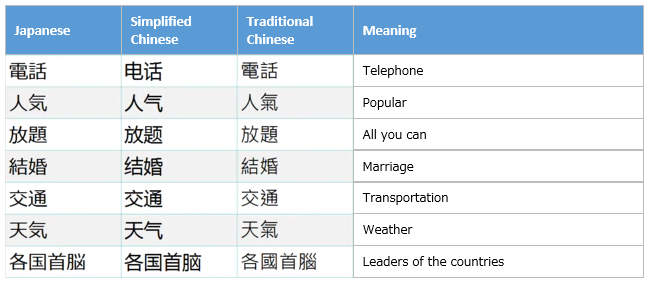
For example, let's see how the word "marriage" is written in Japanese and Chinese.
Japanese: 結婚 Simplified Chinese: 结婚 Traditional Chinese: 結婚
Although simplified Chinese characters are a little different, they look very similar.
The word for "all you can" as in "all-you-can-eat" is very similar as well.
Japanese: 放題 Simplified Chinese: 放题 Traditional Chinese: 放題
The term originated in Japan and was later adopted in China, Taiwan, and Hong Kong because it read naturally in Chinese as well.
How different are Japanese and Chinese characters?
On the other hand, even if the characters are the same or very similar, some words in Japanese and Chinese may have completely different or opposite meanings. More than a thousand years have passed since kanji's introduction, so it's no surprise meanings have drifted apart across cultures.
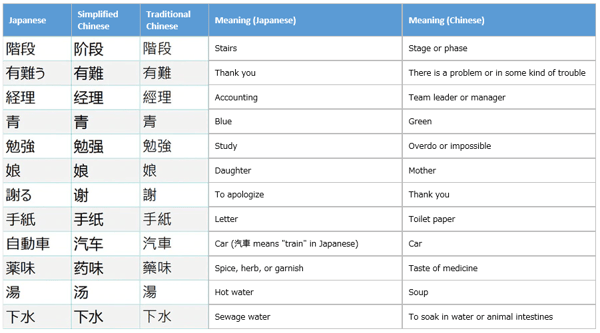
For example, if you write "thank you" in kanji, it will be 有難う or 有り難う, but the word 有難 in Chinese means that you are "in some kind of trouble."
Then, how do you write "thank you" in Chinese? It would be 謝謝 in traditional Chinese and 谢谢 in simplified Chinese. However, the character 謝 has an opposite meaning of "apologize" in Japanese.
Even if you're trying to encourage someone in their studies (勉強), they might think they're forced to do something. Then comes more interesting differences such as a daughter (娘) becoming a mother and a letter (手紙) becoming toilet paper!
This makes clear how risky it is to assume Chinese and Japanese characters are interchangeable just because they look alike.
The first and most important step in working on Chinese translation is to understand the differences and use the appropriate characters, expressions, and terms according to your target region.
Let us take care of your localization projects. In addition to translation services, Kawamura offers numerous options to support your projects such as document reviews by native speakers.
Feel free to reach out to us for a quote or if you have any questions.